The Personal Software Revolution
Part Two: Personal Software
Mr. Narrator, This is Bob Dylan to Me
One thing I've always found interesting, Moore's Law. It's undeniably real, you see it in everyday life, technology getting faster, cheaper, smaller. Thanks to the algorithm and autoplay I accidentally listened to the audiobook of Bill Gates's book on Spotify while "vibe coding," and the part that tickled me the most was how programming looked when he started off as a young nerdling coding between DnD games, coming up at a time where computers were so big and expensive to run, they lived inside giant server rooms in labs and universities.
College students had to rent time to access compute, typing everything into the terminal (yes, that terminal) by hand. It was costly enough that Gates would go on hikes with his buddies and try to write out the code in his head, and then pre-write his programs out in notebooks before he would type them in, just to improve the chances of not wasting precious terminal time. Gates, the little rascal he was, bootstrapped what became Microsoft by sorry-not-sorry "borrowing" time from his University, in what eventually became a bid to slap a GUI on the thing and finally make computing accessible for common folk.
The economics around the early PC and subsequent Internet age are so fascinating to me. Primitive, expensive, early technology wound up getting a lot smaller, cheaper, and way more powerful. It seems like each time this happens, you get tons of fun, unforeseeable side-effects. Mechanize a loom, and before you know it you have t-shirts. In this case, we somehow eventually wound up with iPhones, TikTok, and Elon Musk.
Apple and Microsoft, Dell, and IBM, early on represented the wave of cheapening and shrinking technology, the Personal Computer era. PC — Personal Computer — one of those terms that just kind of loses its original meaning, like "ATM Machine," but ultimately representing taking that machine that ran in a university server room and shrinking it down to the size of something that fit in a "computer den," your office, or living room. The biggest innovations here weren't just the shrinking tech, it was the affordances they eventually unlocked: The graphical user interface (GUI) and the mouse, which made it possible for someone to use a PC without a CompSci degree or knowing how to program. (Sound familiar yet?)
This ultimately combined with the Internet age and allowed all kinds of folk to make websites and apps, publishing all their dumb shit and stuff all over the web until it just exploded into this parallel digital universe we now partially live our lives in today. One predictable phenomenon, you wind up with all kinds of cottage industries and jobs people from 100 years ago couldn't even fathom, frequently industrious little hobbits carving out new, creative niches into these emergent spaces.
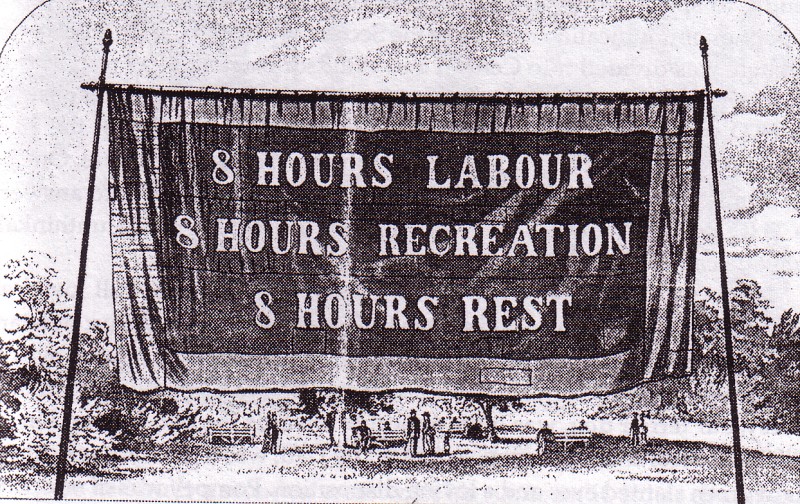
I find it funny that many at the turn of the last century thought industrialization would lead to an inevitable increase of leisure time alongside prosperity. Edward Bellamy's 1888 utopian polemic imagines retirement at 45 due to industrial efficiency, while Robert Owen's career died on the radical hill of days balanced with "[e]ight hours labour, eight hours recreation, eight hours rest," instead of the thirteen to sixteen hours of work common in the day.
Instead we've had productivity feeding back into a profit and growth driven system. The machine of industry does more and makes more with increased output. Instead of giving surplus back to workers as leisure, we made microchips more powerful and cheaper, then put them into the hands of workers so they could "do more with less." I'd love to see the reaction of one of those turn-of-century beardos to the role of "influencer" and the existence of the entire attention economy, wherein leisure itself has become something of its own commodity.
The Internet Era
This era saw similar Moore scale economics at play. Bandwidth was costly, modems were slow, and the technology wasn't yet embedded inside of everything. By god, there was no Internet of Things.
What I find most interesting in these stories are the players who were able to position themselves early on to take advantage of these large scale economic inversions, anticipating the internet becoming so cheap and pervasive, that you'd have it arriving via satellite if need be, on airplanes, in your pocket, and in your coffee maker.
Netflix started off mailing literal fucking DVDs back-and-forth with people before ushering in the ~$160+ billion streaming industry that exists today. (Apocryphally the claim is they were positioning themselves intentionally, in anticipation of the eventual full digitization of streaming media.) Even if not intentional, just doing the right thing at the right time allowed many of the early tech companies to take advantage of these self-reinforcing economic feedback loops, turning them into entire ecosystems and platforms. They started squatting on all of these primitive capabilities of an inherently decentralized and mostly free set of technologies, like email, social media, torrenting => streaming. They convinced people to trade that freedom for subscriptions and "free" ad-supported models, in exchange for the convenience of easy access and elimination of potential "digital piracy" threats.
Shrinking costs, improving capabilities, and expanding new markets powered the rise of Amazon, Google, and every other major online player today, and I'd argue these are the fundamental mechanics these early opportunistic land-grabbers used to transform into the 21st century digital robber baron industries they are today. They just sat on these assets that continued to get "more from less," riding on the coattails of a core dynamic of how technology scales over time, using that inversion to feed a runaway capital growth ouroboros of seemingly endless returns. (But, that's another essay for another time.)
The A.I. Era
Everyone's focus now is on A.I. and data centers, and at its heart are these same dynamics, replayed with a different technology. The compute, power, and infrastructure required to build and run a frontier model remains astronomically high, but this all continues to both get cheaper and easier to run, and importantly, more powerful. Gliding right behind these increasingly capable frontier models is the open-weight category, also continually getting more powerful, and unlike their frontier cousins more accessible.
As of today, accessibility does have some non-trivial cost of entry. I'm able to run a solid coding harness on a Mac Studio that I slapped together using a custom, local, open-source version of Temporal as the harness for orchestration, Fable or Opus as the primary orchestrator, and then a fleet of open-weight models running underneath as the workhorse labor. I set up a Mac user account for the primary agent to run with maximum autonomy, with as much account isolation and security as I can muster around that freedom. The primary agent also has its own email, 1Password access, GitHub, etc. This works solidly for a minimum baseline of preventing it from accessing my personal data, while leaving myself easy access to the machine via either Tailscale and SSH, or just logging in directly.
You could arguably do this all with Linux in the cloud, but I like how running this on a Mac makes it more accessible. It's "freer" in that you've got a one-time hardware cost, so you're not renting open-weight inference or its runtime. A Mac is also more accessible for an average person, which most importantly, then provides an agent with the same exact affordances a real human would have. You can instrument almost any tool use orchestration via CLI or API, but there's a whole layer of ad hoc, autonomous actions an agent can take if you just give it the same access a human would have to a computer.
All of these affordances — local-first, open-weight, PC-runtimes — are important as I think they'll be critical ingredients in unlocking the next shift I see coming with how people interface with their computers and software.
Adventures in Personal Software
I'm anticipating that software will undergo a similar transformation to what we saw when the server room shrank down to the PC. In the same way that a PC made it possible for the average person to do computer things, aided by the affordances of a GUI and a mouse, I think LLMs will create a new class of Personal Software, riding on new affordances in agentic coding that make software development accessible to non-programmers. While this is already a fundamental value prop sold by many of the A.I. companies pushing their coding tool subscriptions, the outcomes they're chasing are pretty clear: they want you renting A.I. in perpetuity, establishing themselves as a critical utility like the Internet and PC previously.
I'm more interested in taking this in a different direction.
The experiment I'm running now is taking agentic coding to its maximalist conclusion, but with a focus on open-weight models for the freedom1 they can afford.
First, create a 100% agentic codebase using frontier models first, because that ensures you have an agent-friendly codebase. Then, reverse engineer it into a clean stack of prompts, skills, and context for open-weight models to then rebuild it back to spec. The goal is to find out how deterministic and replicable I can get the whole thing, because if it can be done, I think there's a ton of humanity-affirming possibilities to unlock.
I'm currently trying this out with Prose, my personal markdown app. The fun thing about this experiment, failure might be one of the most interesting signals. I'm certain if it doesn't work now, it's going to definitely work someday soon either due to better approaches, or the economics of whatever we wind up calling the A.I. equivalent of Moore's Law2.
It's not hard to imagine that in anywhere between 2-10 years we'll be able to run beefy Mac Studio level workloads packaged in MacBook Pro prices and form factors. Apple's just announced the M6, its first 2nm chip, alongside the M5 Ultra, promising nearly a 30% increase in peak GPU compute for AI over the M5 and 1.2 TB/s of memory bandwidth at the high end, which already has folks measuring the drapes for their open-weight coding set-ups.
And it's not hard to imagine that in 2-10 years we'll have an open-weight Mythos/Fable class model that can run on that machine. My timing may be off, but all signs point to this being a question of time not feasibility, a question of when the capabilities, cost, and right approach line up, not if.
I'm betting on what I like to call a "Functional A.I." development approach as one of the key ingredients that will make this all possible, where the emphasis is on the inputs to agentically generate software, measured against the output. These hypothetical stacks of prompts, context, skills, plugins, etc. that feed the inputs for agentic codebases can become the distributed core of a new class of open-source software, the personal software riding the wave of what open-weight models can accomplish.
This opens up a whole world of interesting implications and possibilities.
One implication is that if we can prove this kind of reliable build reproducibility, then this new "prompt stack" becomes a very human-readable entry point for understanding what the codebase is supposed to be. Even if you don't know how to code, your own coding agent makes it easy to grep and audit. Spotting and avoiding dark patterns in an open digital ecosystem then becomes trivial. Extractive economic practices and questionable algorithms are visible from a mile away because the intent and instruction has to be plainly laid out in human-readable language for the LLM to be able to produce code that does that in the first place. The new prompt stack can serve as reviewable, ratifiable documents, which in a perverse way makes the advent of LLMs the fruition of the original idea behind COBOL3, one of the early (and failed) attempts to create a purely human-readable abstraction over the lower-level machine layer.
This level of software accessibility and reproducibility can lead to new forms of local-first, digital decentralization, not last seen since the rise of the PC or Internet of yore. Those fundamental affordances of the past, the GUI, mouse, etc. made it easier for non-tech types who can't program to use technology previously only nerds controlled. LLMs are providing the same affordances, but this time for writing the executable code as usable apps.
If the economics I'm expecting around A.I. play out, in a few years anyone will be able to pick up a reasonably priced laptop and run a Mythos/Fable class open-weight model. This makes the new open-source software economy I envision even more possible — possibly inevitably so — as competent, local coding agents come packaged with your machine, ready and able to customize your apps to suit your needs. Your applications and OS are then something you speak to and adapt to your needs, with the knowledge and intent that you're supposed to have an LLM continue adapting and customizing your software and OS after it ships to consumers.
It also happens that this is the level at which software can best solve problems, because they get solved most locally. You're no longer beholden to the big software companies, trying to create generic solutions that work for everybody.
It doesn't get more personal than one person sitting at a computer, telling it what to do.
Folk Tech
As people naturally lean towards solving local problems with personal software, the supporting infrastructure is also likely to mirror the apps they support, all becoming more local and decentralized. I have a hunch that communities that already mirror these kinds of decentralized architectures will likely naturally plug in to this new type of software ecosystem.
Things like AtProto and ActivityPub already envision a protocol layer that operates in this way, and a small ecosystem of affordable, decentralized infrastructure providers are sprouting up around this, showing the outlines of one of those unexpected new digital cottage industries that tend to sprout up as tech continues getting cheaper, easier, and more accessible. Open-source personal software can run on folk-powered, micro-infrastructure that people form cooperative, non-extractive financial models around, funded directly by the users of the applications who are onboard with the outcomes the software and infrastructure are driving.
Regular folks can then sit down and make all kinds of types of acutely personal software. Take for example a core agentic codebase, developed to manage a farming co-op, which can then have an open-weight, on-machine LLM modify it to suit a particular farm's needs. The base layer of a farm co-op agentic codebase could consist of planning and forecasting tools, compliance and record keeping, sales and distribution software, and more. But then customizations can be one LLM prompt away.
"Spin up this codebase, but customize it based on the following crops, location, etc. Use this API instead of that default free one, it provides better local data for this region."
And the thing that keeps the whole thing on rails is the fact that it can be built on top of a prompt stack which is in part the ratified layer of a reproducible "agentic codebase," initially architected by real software developers who know how to build it right while anticipating a human-language hackable layer for non-programmers to customize atop of.
This provides something like a codebase-level agent harness, guiding local customizations in ways that are idiomatic to that codebase, which means customizations can naturally feed back into the broader software ecosystem as open-source contributions. This can empower all kinds of local-first software customization thriving freely at a local layer that benefits from it the most, while the core essentials remain the common, shared platform. Software improvements developed locally are then naturally shared back as the code base self-improves, becoming more adaptable and customizable for broader community needs based on ongoing individual usage.
Developers can build the affordances for these new modes of interacting with software directly into our apps today. Reporting a bug can result in a new GitHub issue and pull request to the project repo flying off behind the scenes, running freely on local open-weight inference. You can also automate local forking for heavier customizations, bootstrap issue creation and tracking, or provide a built-in CLI to facilitate and encourage local, runtime feature experimentation.
Alongside all of this, a "ratified" prompt stack can leverage copyleft licensing to help keep the ecosystem honest.
I'm trying to think of who in the tech industry could possibly like this type of software economy, and I'm pretty sure it's most companies' worst nightmare.
It disrupts the extractive economics of the "Big A.I." companies, ironically with a reverse extraction technique. We still need frontier models to bear the cost of initial development, but we can extract open-weight freedom in software form following that. This is the opposite of the ecosystem lock-in I'm pretty sure they're assuming they're in a race against each other to lock down with the same types of enclosure tactics "Big Tech" used to pin down social media and other online spaces.
Pretty much any company that lives off of making software is going to have a tough time justifying its bulky centralized software models, when a better more custom local-first alternative is a prompt away. This gets particularly tougher for them if affordable, decentralized infrastructure continues to sprout up alongside this.
Apple and the companies that make money primarily off of selling dumb little apps on their app stores, they certainly wouldn't like this either.
People I think would probably like this: Regular folk who just need software to provide a means to an end. Ultimately, I view this as a vehicle for an idea like folk tech as envisioned by people like LX Cast. It's fun to think about all of this running on Linux boxes too, big beefy Mac Studio level monsters. Valve keeps building cool stuff, SteamOS has certainly helped with Linux adoption, and that new Framework Pro is looking pretty slick with its promise of introducing "the MacBook of the Linux world." (It's ok to want things, all right?!)
The only chokepoint the A.I. companies would have is stopping you from making software with their A.I., which is kind of the whole thing their gigantic bet on A.I. is riding on.
Given these dynamics, I do worry there could be some aggressive postures emerging against open-weight A.I. It's not hard to imagine a future incarnation of the United States or some other country banning (or at least trying to ban) it, but it's equally difficult to imagine putting this genie back in its bottle.
The prospect of what I outlined excites me. In a few years, this might look like speculative fiction, or wishful thinking. For now I view this as one of the (if not the most) positive possible arc that could be running in parallel against the attempted enshittification4 of yet another emerging transformative technology. Unlike the prior technology revolutions, I like the idea of imagining us learning the lessons of the past this time around.
- The freedom of not being locked to a subscription for inference, the freedom to not be tied to one model or lab, the freedom of being able to customize models, and the freedom in the form of transparency in weights.↩
- "Huang's Law" (popularized by the WSJ's Christopher Mims in 2020), named after Jensen Huang's 2018 claim that Nvidia's GPUs had gotten 25x faster in five years, holds that GPU performance more than doubles every two years. It's contested: Epoch AI found GPU price-performance (FLOPS/$) doubled only about every 2.5 years between 2006 and 2021. On the training side, OpenAI's 2018 analysis found compute for the largest runs doubling every 3.4 months, but that trend broke shortly after publication; Epoch's current estimate is 4–5x per year, or a doubling closer to every five or six months.↩
- The original intent behind COBOL was to make reusable code that was also still human-readable by the management layers of the Department of Defense. This was one of the original swings at one of the toughest computing nuts to crack: solving common repeatable problems with reusable software across different types of machines, rather than having to rewrite the same programs from assembly each time as they previously did.↩
- Is it just watermarking to comply with an EU law? More than one thing can be true, and this certainly would give Anthropic a thread to pull on in the future should they decide they want to bring the hammer down on the open-weight ecosystem that partially thrives on training against frontier lab outputs.↩